A Free Sample from A Christmas Angel
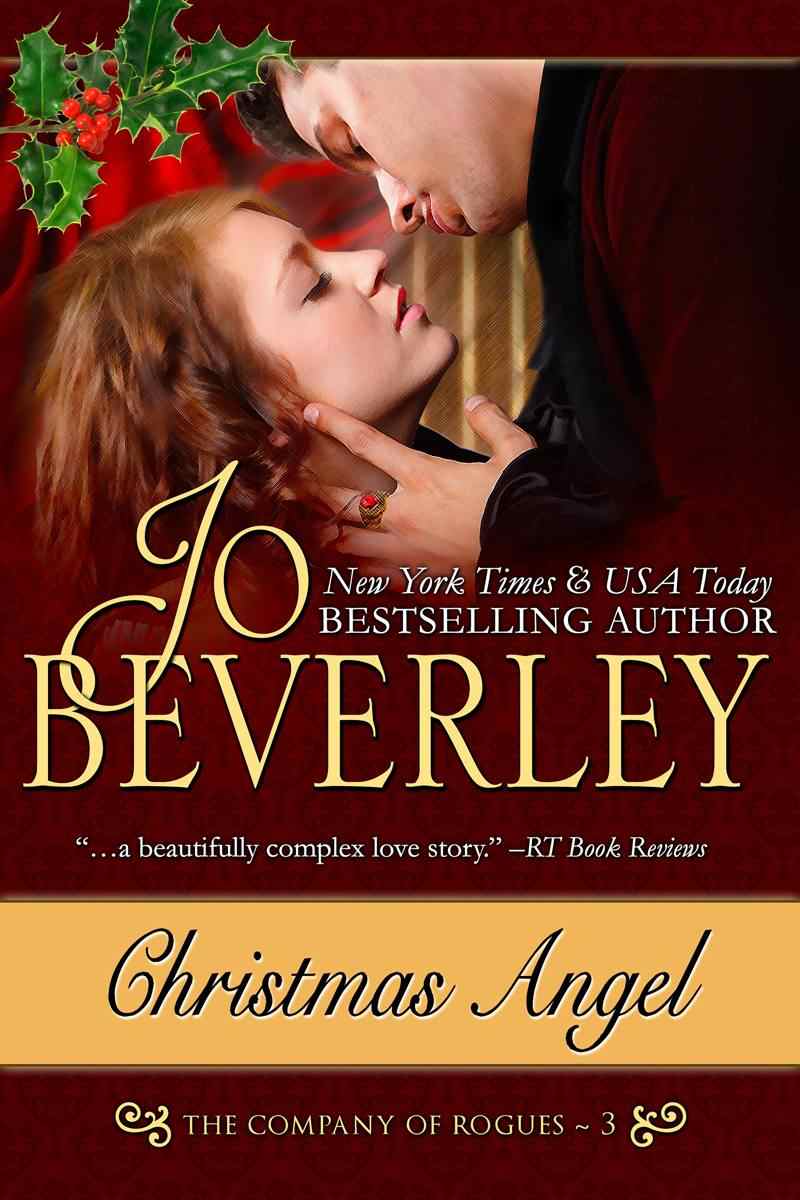

Cover of the e-edition. Cover of the print edition, October 2013
Winner of the Readers' Choice Award as Best Regency Romance.
Waldenbook's Award for Bestselling Regency Romance.
"Ms. Beverley exquisitely crafts a beautifully complex love story that will become a treasured addition to every regency connoiseur's bookshelf." Melinda Helfer, Romantic Times
If you want to buy the e-book click here.
"Sorry if I was eavesdropping," he said, "but no one can resist the sound of their own name. Do I gather you have a candidate for my hand?"
It was all very light but Beth sensed a serious interest. Whatever was motivating Leander Knollis it was not a whim soon to be forgotten. She purposefully didn't look at Lucien. "I thought so, but Lucien has pointed out that she's ineligible on all counts."
Leander picked a straw out of a bale and twirled it. "Not on all counts, surely. You are far too clever to have scored a duck, Beth. What makes her eligible?"
Beth shrugged. "She's highly unlikely to fall in love with you. It's the local melodrama. She was married to Sebastian Rossiter, a poet who rented Mayfield House in the village. He died before I married Lucien, so I never met him, but at the drop of a hat any of the locals will tell you the affecting story."
"It'll affect you to nausea," Lucien interjected, shrugging into his jacket. "Sebastian Rossiter was a strip of dreamy wind with long flaxen ringlets -- I'll swear he put them in curling papers -- and long, limp white hands. I'm surprised he managed to beget two children."
"He was very beautiful," countered Beth firmly, "or so the local ladies say. He was also gentle, kind, generous, and utterly devoted to his wife. They were madly in love, never apart. He wrote nearly all his poems about her, or to her. I believe one had a minor success -- My Angel Bride."
Lucien emotively quoted, "Though Angels throng the Heavens high,/ And bend to soothe each human sigh,/ Mere man's bereft on this bleak earth/ Lacking an Angel by his hearth." Though he declaimed it satirically, even he could not entirely blight the beauty of the sentiment. "There's more. Let's see... "My Judith sits in God's pure light/ And holds our child to bosom white./ And dew that pearls the gleaming grass/ Shows Angels' envy as they pass."
"I certainly couldn't compete with that when courting."
Lucien shook his head. "I'd disown you if you were to try."
"So," said Leander, "what are the impediments to the match?"
"Two children," said Beth.
"How old?"
"A boy of eleven and a girl of six."
Leander considered it. "I don't see any problem there. The boy is old enough not to become confused about our own children and the inheritance. In fact," he said with a sudden inexplicable gleam in his eye, "I'd quite like a ready-made family."
Beth shared a look with Lucien.
"Lee," said Lucien, "think how old that makes her."
Lee considered. "Over thirty?"
"Not quite that, I suppose, but you're only twenty-five."
"Why the heat? Nearly all my lovers have been older than I. In fact my father's firm advice was to have nothing to do with a woman younger than myself until I was at least thirty. I should have listened. If I'd gone bride-hunting among the older set from the start I'd have been far more likely to find a woman of sense, one too wise to make a fool of herself over me."
He nodded contentedly. "Marriages of practicality are still common on the Continent, you know. I'm not uneasy at the notion. As long as this widow's still likely to bear me a few children, I don't care about her age. However, I see no reason why the lady would consider me if she still grieves as much as you say."
Beth was succinct. "Money."
"Poetry not lucrative?"
"One gathers not, though My Angel Bride was on every sentimental school-girl's lips a few years back. Not everyone can be a Byron, I suppose. When Mr. Rossiter died the widow had to leave Mayfield House and take a cottage in the village. I gather she is one of a large family of a curate and can expect little help from that quarter. Her son is coming to an age to need schooling and a start in life. It's possible that she has been able to put money aside for her children's future, but I doubt it."
Lee leaned against the edge of a stall and stroked a horse's nose. "I have to confess, it seems a situation cut to my requirements." He looked at Lucien. "What bothers you?"
"Go to hell in a handcart if you wish," said Lucien shortly. "But," he added, putting a hand on Beth's shoulder, "love in marriage is not a thing lightly to dismiss."
Judith Rossiter straightened from the washing tub, hissing as her back complained. She hated washing-day. She had the sheets and underclothes boiling in one corner of the small kitchen, and was wringing out the colored garments. Her hands were red and the room was heavy with sour steam.
She was nearly finished with this task, but it seemed that the work was never, ever, done. Now she had scraped together the money to buy more dried fruit, she had to chop it for the Christmas mincemeat. That meant there were raisins to be stoned, another job she disliked.
Perhaps she should look on the bright side; poverty had reduced the number of raisins to be stoned.
She sighed over it. If she put in lots of apples maybe no one would notice the lack of imported dried fruits. She was determined, one way or another, to give her children a proper Christmas.
She threw the last item into the tub and called Rosie to help her to peg out. She hauled the tub onto her hip, and went out into the garden.
She was assailed by delicious, fresh, cool air, and stole a moment to relish it.
It was a lovely late autumn day. The air was crisp, the sky clear blue, and the leaves on the trees were russet and gold. As she watched, some drifted down to join the gilded carpet on the ground.
When Sebastian was alive they would walk out on days like this, across fields and through woods. The children would run about and explore, while Sebastian thought up elegant phrases and noted them in his book. Judith would just drink in the sights, the sounds, and the aromas, and be content.
There had been money then. Not a lot, but enough with careful management for a cook, two maids, a gardener, and leisure. Time and security, the two things she missed most.
Six-year-old Rosie, a pretty girl with her father's fly-away pale blond hair and her mother's big blue eyes, came running to help. She passed the pegs and supported trailing ends as Judith fixed the laundry to the rope.
By the time they'd come to the bottom of the tub, Bastian, as her second Sebastian was always called, came out. "Can I help you with the prop, mama?"
Judith smiled. "Thank you, dear. That would be wonderful."
The two children fixed the forked end of the long stick under the line then pushed up, settling the other end securely in the earth. They checked the laundry was raised well away from ground and bushes and that the prop was secure then turned, well-satisfied with themselves.
Judith gave them both a hug. She was blessed with wonderful children. They didn't complain at their simple life, and they did their best to help with the work. They were her greatest joy, but also her greatest concern. She noted that Bastian's head was up to her shoulder now. Her first babe was growing fast, too fast. Keeping him in clothes was a strain on her purse, and she had no idea how to provide for his future.
She knew her own family would always give her and the children a roof over their heads, but more than that was impossible. Sebastian's family were not particularly wealthy either, but they had provided a small but adequate annuity for him when he decided to set up as a poet. It had continued even after his parents' deaths, and been sufficient. Judith had not known that income would die with Sebastian.
That blow, on top of his sudden death, had almost undone her. She had written to his brother and received help. Thank heavens for Timothy Rossiter. If it weren't for that small quarterly allowance, she didn't know what she would do. From his letters, she feared Timothy could ill-afford it, but she could not refuse to take it.
If only Sebastian's poems had made money, even a little, but instead he had actually paid to have them printed -- on vellum, bound in Cordovan leather -- and then given the handsome copies away. It had seemed a harmless indulgence when the money had been available, but now she grudged every glossy leather volume.
He had kept one copy of each work. They sat in a row in the front room of the cottage -- eight slim volumes full of poetry about her. Her sole inheritance.
She was occasionally visited by the traitorous thought that real devotion would have been more provident.
She had just enough money for this austere life, but there was nothing to spare. Even the fee for an apprenticeship in some skill would be a perilous expenditure, and Bastian was entitled to more than that.
"Mama." Bastian's voice was a welcome interruption to depressing thoughts. "You know Georgie's rat?"
Judith shuddered. She knew Wellington all too well. Georgie was Bastian's closest friend, and Wellington was Georgie's inseparable companion. The creature was well-behaved and even seemed clean, but she still had an urge to beat it with a broom.
Bastian took the shudder as answer. He sighed. "I don't suppose you'd let me have one..."
"No!"
"But it wouldn't eat much, and Georgie's found another clutch of babies. He's taking one for himself, because Wellington's getting old-"
"No, Bastian. I'm sorry, but I could not tolerate a rat in the house. Off you go now, both of you and finish your work." Impulsively, she decided the raisins could wait. "When I'm finished the whites," she promised, "we'll walk down to the river."
They hurried back into the house, and Judith sighed. Really, they asked for so little, and got even less... But a rat! The Hubble's cat had just had kittens. Perhaps she should take one, and that would do as well...
Judith went back to the laundry, popping into the front room of the cottage to check that the children were doing their work correctly, and praising them. They were both so bright and good. They deserved a chance in life. Was she to see them end as servants?
As she began to haul the steaming whites out of the boiler and into the rinse water, she thought bitterly that a more useful woman would be able to earn some money -- be able to write novels or paint pictures. Something with a marketable value. The only thing of excellence she could create was elderberry wine. She looked at the rows of newly-bottled wine, her hope of some small increment to their income, and sighed.
They would make no impression at all on her desperate situation.
Leander told the publican that he was a guest of the Marquess of Arden and soon had the beefy man chatting. It was a natural skill of his to put all kinds of people at their ease.
"And I hear you had a famous poet in these parts?" he asked at one point.
"Aye, sir. Mr. Rossiter. He could spin a lovely verse, he could. Had 'em printed up in Lunnon."
"Died, I hear."
"Aye, over a year back." The man shook his head. "Took a chill and it settled. Never did have the look of a hearty man, if you know what I mean. Once or twice I said to him, `You ought to take to drinking stout, Mr. Rossiter,' I said. But he mostly drank tea and water, and never a barley brew. And look what come of it."
Leander took a deep draught of his ale to prove he wasn't so foolish. "Indeed, but perhaps it's the poetic temperament. So many of them seem to die young. Did he have family hereabouts?"
"Came from Lunnon, as I hear tell, sir. But he married a Hunstead girl. His wife and children still live in the village. If you know of him, you'll know of her. Wrote nearly all his poems to his Judith."
"Ah yes." Leander put on a sentimental expression. "My Angel Bride."
"That's right, sir!" declared the man with a pleased smile. "Can't say I go for that sort of rhyme misself, but the womenfolk love it."
"It was a very affecting piece. Does the lady live nearby? I would like to gain a glimpse of her."
The innkeeper gave him a narrow look then shrugged. "She seems to be quite famous. I've been asked afore." He gave directions to the cottage. "You might care to visit Mr. Rossiter's grave, sir. A very touching monument his widow raised, I must say." He leant forward confidentially. "Round here they call her the Weeping Widow, took it so hard she did."
Well, why not? A wise soldier scouts the territory before going into action. Leander paid for his ale, checked on his horse, and strolled off toward the village church and graveyard.
The church was ancient -- he thought he saw Saxon work -- and the churchyard was graced with mighty spreading trees and old, tilted stones covered with moss. Beyond the ranks of stones the land sloped away down to the same river that wound along the edge of the gardens at Hartwell.
He wandered through the churchyard looking for the poet's grave. It was easy to find because of its newness and grandeur. In fact, it looked very out-of-place. An angel drooped on a pedestal, weeping, two cherubs at its -- her? -- knee.
He read the inscription.
In loving memory of Sebastian Arthur Rossiter, Poet
Born May 12th. 1770. Died October 3rd. 1814.
Sadly mourned by his wife Judith
and his two children, Bastian and Rosie.
He had been a good deal older than his wife, then. Leander had gained the impression that he was a young man. There was a verse engraved below.
When I am gone to rest be sure, my dear,
That I will watch and treasure every tear.
On high, forever faithful, I will wait
Longing to greet my angel at the gate.
Presumably the poet had composed his own epitaph. Leander thought it distastefully morbid and possessive but noted there were fresh flowers on the grave. He questioned his plan. Would there be a ghost in the marriage bed?
Pondering this, he continued through the graves and down the slope to the river's edge to idly toss stones into the shallow water.
He wondered whether Judith Rossiter really did long to join her dead husband; what it was like to feel such grief. He hadn't mourned his parents, for his father had been too wrapped up in his work to engender fondness, and his mother had been too wrapped up in his father. He'd grieved for the death of a number of brothers-in-arms, but he'd felt damn-all desire to share their fate.
If this miserable clinging was the consequence of love he was better off without it.
But then he found himself thinking of Lucien and Beth. They'd made him welcome and not at all uncomfortable, and yet he sensed the power of the bond between them. They fought -- which wasn't surprising in view of Lucien's blue-blooded arrogance and Beth's egalitarian principles -- but they were bound together in a way no petty disagreement could touch.
That, he supposed, was love. But he couldn't imagine, if either Beth or Lucien should die, them wanting the survivor to hurry to meet them.
It would be hell to be married to a woman who thought only of joining her first mate in the grave. He laughed at his situation. It appeared his choice was either a wife who drooped over him from excessive devotion, or one who did the same from excessive grief.
Really, Vienna would be a far more sensible choice...
He heard the laughter of children and turned just as they ran into view between the gravestones and headed down the hill. He thought they were the Rossiter children. They paused momentarily but then came on -- startled by a stranger but unafraid. They seemed unsure, however, as to whether to speak or not, and so he did. "Good day. Do you live around here?"
The boy gave a little bow. "Yes sir. In the village." He was handsome, with dark curls and an attractive confidence in his manner.
"I'm staying with the Marquess of Arden," Leander offered as credentials. "He has a place farther along the river, as you doubtless know. My name's Charrington. Lord Charrington."
The boy bowed again. "Pleased to meet you, my lord. I'm Bastian Rossiter, and this is my sister, Rosie."
It was them indeed. Was this a augury from the gods?
The girl, who had bewitching deep blue eyes and flaxen hair like silk on her shoulders, drew herself up. "Rosetta," she said firmly.
Her brother groaned, but Leander gave her a very proper bow. "Delighted to make your acquaintance, Miss Rosetta Rossiter." With a grin that showed two charming dimples she returned the honor with a curtsy.
Leander looked up to find their mother had come up behind, a neutral expression on her face, but wariness in her eyes -- large blue eyes, just like her daughter's, but made even finer by thick dark lashes. She didn't look lugubrious, thank God. In fact she looked sound as a ripe peach. He glanced meaningfully at Bastian and the boy took the hint.
"Mama, may I present Lord Charrington? He's staying at Hartwell. Sir, this is my mother, Mrs. Rossiter." Then he looked between them anxiously. "Did I do that right?"
"Perfectly," said Leander, and was rewarded by a touch of warmth in the widow's expression. She held out a black-gloved hand. "My lord."
He took it, making rapid inventory. She was above average height so her lovely eyes were almost on a level with his own. Her dark hair was now firmly tamed under a plain black bonnet. Other than those eyes, her face was unremarkable except for a hint of roundness in the cheeks. He suspected there'd be dimples if she ever smiled. The roundness and the eyes gave an impression of youth that most women would envy.
Perhaps that illusion of youth was what suddenly made him feel protective, or like a knight errant come to rescue the lady in the tower. He was drawn to her. He wouldn't at all mind taking her to wife. Should he seize the moment?
To achieve anything, he needed to keep her in conversation. Presumably the easiest opening would be the dear departed. "If I may be so bold," he said, "I assume you to be related to Mr. Rossiter, the poet."
"That is so," she said without particular warmth, most of her attention on her children, who were walking ahead. "I am his widow."
"A sad loss. Please accept my condolences."
"Thank you."
She was clearly not thrilled by this conversation. The children had run off to investigate the shallows of the river, and she moved to follow them.
Leander went along. It was refreshing that she wasn't blushing and simpering at first acquaintance, but he found that for once in his life he was struggling for something to say. "This is a beautiful churchyard in which to take his final rest."
She glanced at him. "It is indeed a charming spot, my lord, though I can see no reason, sentimental or spiritual, why the dead should be supposed to care."
As she walked on, Leander realized he was making a fool of himself. Clearly, no matter how deep her grief, the widow was not to be reached by the sentimental route. For a moment he was annoyed by the absurd situation in which he found himself, but then he smiled and adjusted the tilt of his elegant beaver.
By her cool behavior the lady had passed the last test. There was nothing about her he found objectionable.
The wisest course now would be to seek some conventional way of courting her, but that could be difficult. Beth had told him the Widow took no part in County life, and had little free time. He wanted all this settled so he could get on with his plans. He couldn't spend months hanging around Surrey.
Why shouldn't he just press his suit? He was, after all, the one who had managed to pacify the Duke of Brunswick after he had been insulted by one of the minor Bourbons and was flirting with the idea of throwing his state behind Napoleon. Persuading a penniless widow to become a countess should be child's play.
Still, he hesitated.
He hesitated, he realized, because he cared about the outcome. There was something about this composed woman which made him want to know her better, and ease her way in life. He was attracted to her children.
Good God, he actually wanted to marry her!
She stopped her stroll and glanced back at him, clearly wondering about his actions. A slight smile tugged at her lips. "Should I apologize, my lord? I fear I shocked you."
There was the faintest hint of dimples.
She was referring to her comment about the dead. He walked to join her. "No," he said, "but I fear I am about to shock you." A flicker of wariness passed over her face and she glanced once at her children, made a move toward them.
"Please," he said quickly, "I'm not going to do anything you wouldn't like.... Good heavens! Would you believe I was reputed to have a golden future as a diplomat?"
She relaxed slightly, and her lips twitched. Those dimples flickered once again. He conceived a strong desire to see them in all their glory.
"Not at this moment, no," she said. "Is there some way I can help you, my lord?"
He pulled himself together and gave her one of his best smiles. "Yes, in fact there is. I would like to talk to you about it. I see a stone over there well shaped for sitting, if it would not be too cold."
After the briefest hesitation she walked toward it. "Not at all. I usually do sit here while the children play. They call it my throne."
She sat on the lump of granite, gathering her black bombazine skirts neatly together. With permission he sat beside her. There was not a lot of room but she made no silly protest about them sitting so close. He liked her more by the moment. She turned to look at him with polite expectation.
"You are going to find this a little strange..."
"And even shocking," she added quizzically.
A sense of humor as well. "I hope not too much so." He still could not quite see how to open the subject.
There was distinct amusement in her eyes. "I'm likely to be so overwhelmed with curiosity, my lord, that I'll take a fit of the vapors, and scare you to death. Have pity, please."
He laughed. "One of the first lessons a fledgling diplomat learns, Mrs. Rossiter, is how to handle a lady with the vapors." Even so, he couldn't imagine this woman in a state of collapse. For a moment he wondered if he had the wrong lady and was about to propose to the vicar's wife or such. But then he remembered that she had admitted to being the poet's widow.
He braced himself. "Despite my diplomatic background, Mrs. Rossiter, I can see no fancy way to dress this up that would serve any purpose at all." He summoned up an expression of sober worthiness. "The simple truth is that I would like to marry you."
She paled. In a second she was up and standing, looking away. "Oh, good heavens," she said. The tone was pure exasperation.
It was not a response he had expected. He rose to his feet too. "It may be precipitate, but it is an honest offer, ma'am."
She turned back, eyes snapping. "Honest! When you don't know anything about the woman you are proposing to take to wife?"
"I know enough."
"Do you indeed? I can't imagine how. Well, so do I know enough. The answer, sir, is no."
She was marching away. Leander hurried after, feeling more like a green boy than he had since he was sixteen, when he'd tried to kiss a daughter of the Duke de Ferrugino and had his face soundly slapped. If the Rogues ever heard of this they'd die laughing.
He caught up to her. "Mrs. Rossiter. Please listen to me! I can offer you all kinds of advantages."
She whirled around in a swirl of black skirts to face him almost nose to nose. "Name one. And no, I do not need any more odes to my eyes!"
He stared at her. Those eyes were so magnificent filled with rage that he was tempted to try. But he said, "That's as well. I wouldn't know where to start."
She took a step back. "You are not a poet?"
He extended his hands. "Diplomat. Linguist. Soldier. Earl. No odes on any subject, I give you my word."
"Earl?" she asked dazedly.
He bowed, thinking that at last they were making progress. "Leander Knollis, at your service, ma'am. Earl of Charrington, of Temple Knollis in Somerset."
"Temple Knollis?" she queried faintly, showing the awe with which he was all too familiar. At the moment, however, he'd take any advantage he could get.
"Yes. There's a London house too, and a hunting box. An estate in Sussex, and a place in Cumberland I've never seen." Good lord, he thought. I sound like the veriest mushroom listing off my properties like this.
Perhaps she thought the same. Color flushed her cheeks. "I don't know what game you are playing, sir, but I think it unconscionable of you to amuse yourself at my expense. Bastian! Rosie!" she called out. "Come along. We must leave."
The children ran over. Bastian took one look at his mother and turned on Leander pugnaciously.
Leander backed off. "Don't fight me, lad. I'd have to let you win or your mother will never marry me."
The children stared at them both wide-eyed.
Judith Rossiter, however, glared at him as if she'd like a mill herself. He saw her hands were clenched into serviceable fists. "Good-day!" she snapped and stormed off up the hill, her children running behind. She was like a ship of the line with a pair of pinnaces in tow. He could quite imagine that at any moment she would turn and broadside him into oblivion. Leander watched them go, wondering ruefully what had possessed him to so mishandle matters.
If you enjoyed this excerpt, you could  tweet about it
Click on it and you will be able to preview it before it goes.
If you're ready to buy, here are the links.Amazon US
Amazon Canada
Amazon Britain
Amazon Germany
Amazon France
Amazon Spain
Amazon Italy
Amazon Japan
Amazon India
Amazon Brazil
For Nook
iTunes
I have an author page on Facebook, where I post fun news about life, research and books on most days. Click on the face!

To keep up to date on new and reissued books, ask to receive the occasional e-mail newsletter.
| Receive Jo Beverley's newsletter. | ||
| Browse Archives at groups.google.com | ||